Designing a Passive Safety Net for Seniors Living Alone
Open Government Product (OGP) Hackathon · Product Design · 2024
Role
Product Designer (Sole Designer) · Designed sensor housing, AAC dashboard end-to-end, user research synthesis and consolidated hackathon pitch deck
Team
Timeline
Sep 2024 - Oct 2024
Overview
By 2030, seniors living alone in Singapore may rise to 83,000
More seniors in Singapore are ageing alone than there are care staff to check on them. In an OGP hackathon, my team partnered with Jia Ying Active Ageing Centre (AAC) to create Birdhouse. The passive monitoring system turns senior’s activity pattern into timely insights for caregivers. It was later piloted in a community care setting and recognised as a winning solution.
1
4
11
1500+
Context
In 2023, the Singapore media reported 37 lonely deaths
Some were discovered weeks later and these were only the cases that made the news. As more seniors age alone, the risk of unnoticed deaths grows.
Active Ageing Centre caseloads are rising, but check-in capacity is not. Staff cannot call every senior daily, so those who go quiet may be found late, or not at all.
Research
What we learned on the ground


We spoke with AAC staff, independently living seniors, family caregivers and eldercare experts to understand how check-ins work today, and where visibility breaks down.
1
Daily check-in cannot scale with growing caseloads.
AAC staff are responsible for growing numbers of seniors, making manual monitoring increasingly unsustainable.
2
Emergency buttons require action; installed monitoring systems are costly to scale.
High installation costs, maintenance complexity, and fragmented systems limit adoption across multiple households.
3
Trust, privacy, and cost strongly influence adoption.
Any solution perceived as intrusive or difficult to explain to seniors would face resistance from both users and caregivers.
Solution
Birdhouse: quiet monitoring, timely care
Rather than creating another emergency alert system, we focused on passive reassurance. We established three principles that guided every design decision:
Passive & senior-friendly
Monitoring should require no behavioural change, minimal setup, and no active interaction from seniors.
Proactive & smart
The system should surface deviations from normal patterns early, rather than only reacting to emergencies.
Build for care workflows
Outputs should reduce cognitive load for AAC staff by summarising data into clear, actionable insights.
These principles shaped Birdhouse, a modular system with three connected experiences:
1
For Seniors
Low maintenance, low cost motion sensor that fits seamlessly without manual actions required

2
For Caregivers
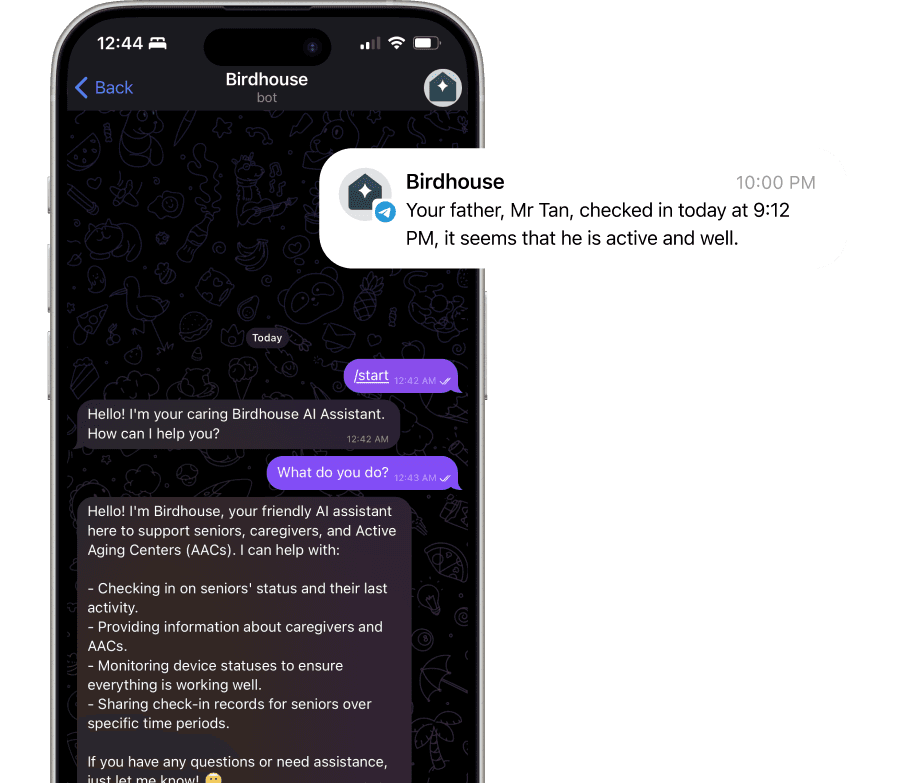
A chat-based assistant gives family members simple status updates and alerts without requiring another app.
3
For AAC
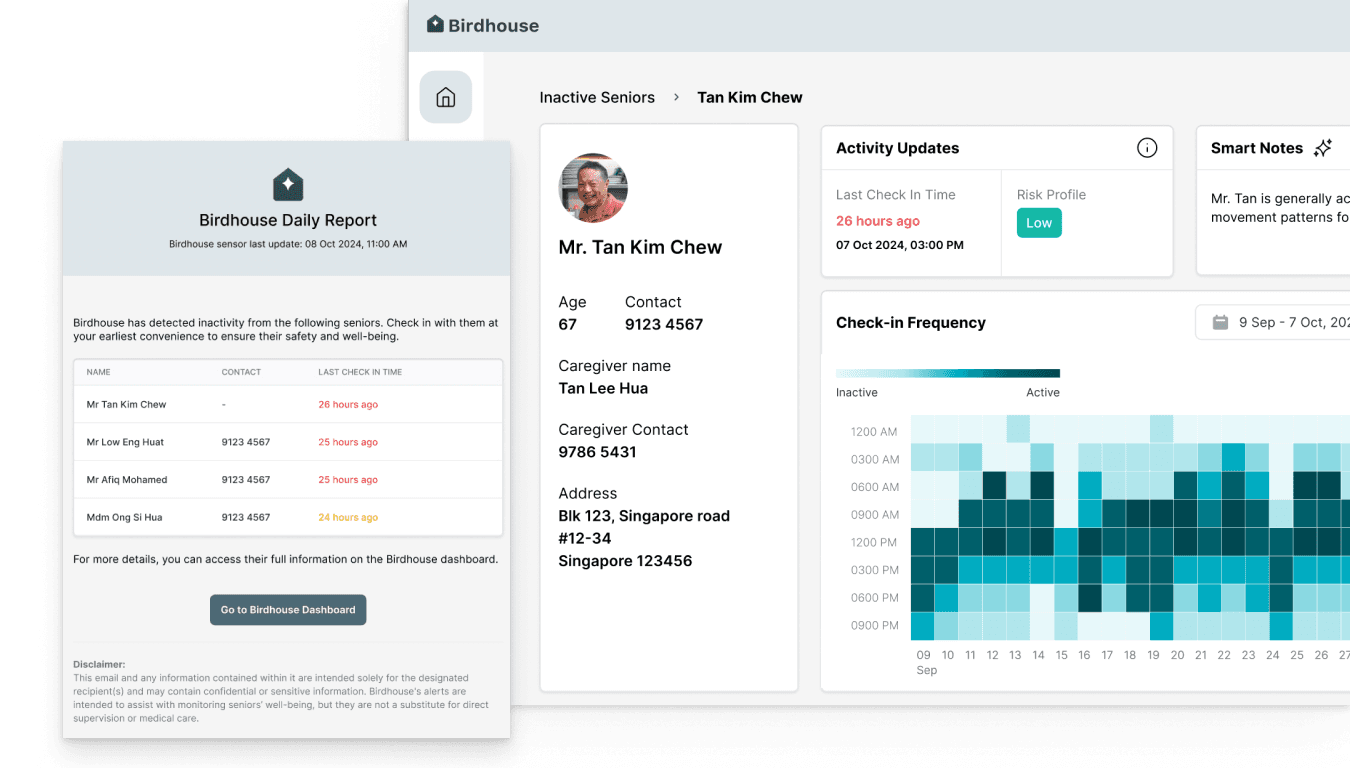
Daily reports & dashboard turns activity data into a prioritised list for staff monitoring many seniors.

Design Deep Dive · AAC Dashboard
From activity data to actionable care priorities
Beyond designing the housing for the motion sensor, I explored how raw activity data becomes clear, actionable care signals. As the solution evolved, we realised the caregivers and AAC staff needed different experiences: caregivers usually monitor one person; AAC staff may oversee many. The same data therefore needed two different experiences: reassurance for families and triage for staff.

A daily email, because no one opens a dashboard first
The email surfaces only seniors with unusual inactivity and links directly to the relevant dashboard view.

Home page opens directly on a scannable triage list
Each row shows the senior’s status and last detected activity, so AAC staff can scan the whole list at a glance and decide who to check on.

Lead with the care signal, then show the evidence
AAC staff get the plain-language summary, followed by the underlying activity timeline, reducing cognitive load and interpretation effort.
Pilot Feedback
Hear it from the users
Over 11 days in 4 homes, we asked the people on both ends of the system, the seniors living with the sensor, and the staff reading the dashboard, whether Birdhouse earned its place.
“
The AI is good and easy to use, very useful as it allows us to know that the senior is safe at home.
— Jia Ying AAC Staff
“
I don’t mind it (Birdhouse) there for 365 days, it doesn’t hurt me, it’s useful, should I faint, I’m ok!
— Senior #1
“
We are ready to find another 50 seniors to install Birdhouse.”
— Jia Ying AAC Staff
Reflection
Building, testing, and learning in a month


One data set, different needs
Caregivers need reassurance; AAC staff need prioritisation. Good design starts by framing information around the decision each audience needs to make.
Reassurance over more data
More data does not always create more clarity. The stronger experience is often the one that surfaces fewer, more meaningful signals and helps people act with confidence.